Field observation and technical perspective
Road underpasses improve traffic flow by separating road levels, but their geometry creates a demanding stormwater challenge. Because the carriageway is lower than the surrounding network, rainfall runoff naturally travels toward the underpass. The drainage system must therefore receive, convey and discharge water quickly enough to keep the route safe and operational.
The photographs in this article document drainage units installed along an underpass in the wider Casablanca mobility corridor. Each visible unit combines a large kerb-level intake with an upper access cover. Surface water moving along the road edge can enter through the side openings, while the cover provides access to the chamber below for inspection, sediment removal and maintenance.
Important engineering principle
A kerb inlet is the visible entry point of a much larger system. Its performance depends on the catchment, road gradient, inlet spacing, underground network, pumping strategy where required, emergency overflow planning and maintenance condition.
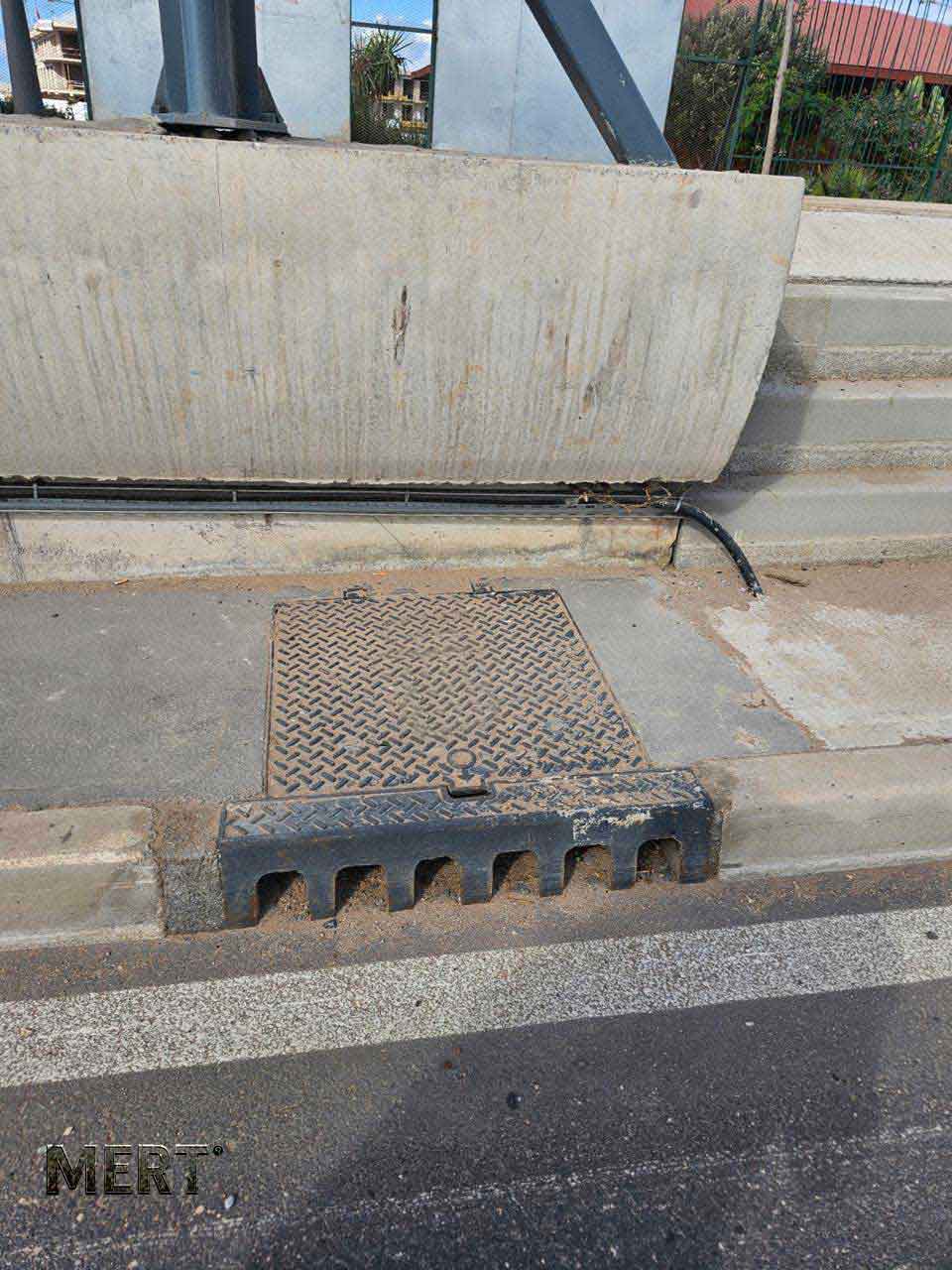 Combined kerb-level stormwater intake and upper access cover. The front openings receive road runoff, while the cover supports inspection and cleaning of the chamber below.
1. Understanding the risk
Combined kerb-level stormwater intake and upper access cover. The front openings receive road runoff, while the cover supports inspection and cleaning of the chamber below.
1. Understanding the risk
Why underpasses can collect water so quickly
An underpass is often a hydraulic low point. Water may arrive not only from the lanes inside the structure, but also from entrance and exit ramps, adjacent carriageways, pavements, retaining-wall areas, junctions and nearby developed surfaces. A short, intense storm can generate a large flow within minutes.
Flood risk increases when inlet capacity is too low, when the underground network is undersized, when pumps or power supplies fail, or when sand, leaves, plastic waste and construction debris reduce the available opening area. This is why underpass drainage should be treated as a safety-critical infrastructure system rather than a minor road detail.
Low-point geometry
Runoff follows the road gradient and concentrates at the lowest part of the underpass.
Rapid rainfall intensity
Short-duration storms can create peak flows that exceed normal drainage conditions.
Debris and sediment
Sand, leaves and waste can obstruct openings and reduce effective intake capacity.
Maintenance dependency
Accessible chambers are essential for cleaning, inspection and corrective work.
2. System function
How the photographed kerb inlet and access system works
The visible installation uses two complementary access paths: a horizontal intake at kerb level for water and an upper cover for maintenance personnel. This arrangement allows the road edge to guide runoff toward the chamber while keeping a large service opening available above it.
Kerb-level intake
Water travelling along the road edge enters through the front openings. The geometry helps collect flow close to the kerb, where runoff is normally concentrated by the crossfall of the carriageway.
Underground collection chamber
The chamber receives the water and connects it to the underground stormwater network. Depending on the project, the system may also incorporate sediment space, outlet connections, sumps, pumps or monitoring equipment.
Upper maintenance access
The top cover allows teams to inspect the chamber, remove accumulated material, clear blockages and examine connections. Maintenance access is not an optional convenience: it is part of the long-term hydraulic performance of the system.
3. Design responsibility
What engineers must evaluate before specifying an underpass drainage solution
No single inlet or cover can guarantee that an underpass will remain flood-free. Product selection must follow the hydraulic design of the complete system and the operational requirements of the road authority.
| Design factor |
Why it matters |
| Design rainfall and return period |
Defines the storm intensity and volume that the system is expected to manage under the selected design criteria. |
| Contributing catchment area |
Includes ramps, lanes and surrounding paved surfaces that direct runoff toward the underpass. |
| Road gradient and inlet spacing |
Controls where water concentrates and how many collection points are needed to limit bypass flow. |
| Underground pipe and chamber capacity |
The inlet cannot perform effectively when downstream pipes, chambers or outlets are restricted. |
| Pumps, controls and backup power |
Where gravity discharge is not possible, pumping reliability and emergency redundancy become critical. |
| Debris management |
Opening geometry, sediment control and cleaning frequency affect the available intake area during storms. |
| Load class and installation zone |
The frame, cover and surrounding construction must be selected for the actual traffic and site conditions. |
| Inspection and maintenance plan |
Regular cleaning, documented inspections and pre-storm checks preserve system performance. |
4. Casablanca project context
Independent references for the wider RR320 mobility programme
The underpass photographs were taken within the wider road infrastructure environment associated with mobility improvements between Casablanca and the Province of Nouaceur. The official Casa Amenagement project page describes a programme intended to increase road capacity, improve journey times and strengthen road safety. Independent reporting by Le360 documents the Route d'Azemmour (RR320) works and the commissioning of four underpasses.
What the references confirm - and what they do not
- 1The official project source confirms the broader Casablanca-Nouaceur mobility programme and its transport objectives.
- 2Le360 reporting identifies the RR320 widening and the construction of four underpasses, with the first opening reported in November 2024.
- 3Later Le360 coverage reported that the four Route d'Azemmour underpasses were operational in January 2025.
- Scope note: these external sources document the road project. They do not independently confirm the manufacturer, hydraulic capacity or contractual supplier of the specific drainage units shown in the field photographs.
Project videos
The videos below provide additional public context on the Route d'Azemmour works and underpass openings. They are embedded as third-party project references and remain the property of their respective publishers.
Route d'Azemmour development: project overview
External video published by Le360. Opens project context beyond the drainage details shown in the field photographs.
Opening of a second Route d'Azemmour underpass
External video reference documenting the commissioning of another underpass on the corridor.
5. Whole-life performance
Why accessible maintenance is as important as intake capacity
Underpass drainage systems operate in a harsh environment. Tyre particles, road dust, sand, litter, vegetation and construction residue can enter the drainage path. Even a well-designed inlet can lose performance when openings or downstream connections are partially obstructed.
A practical maintenance programme should include routine visual inspection, removal of sediment, cleaning of all intake openings, checks of chambers and pipes, testing of pumps and backup systems where applicable, and documented inspections before forecast periods of intense rainfall.
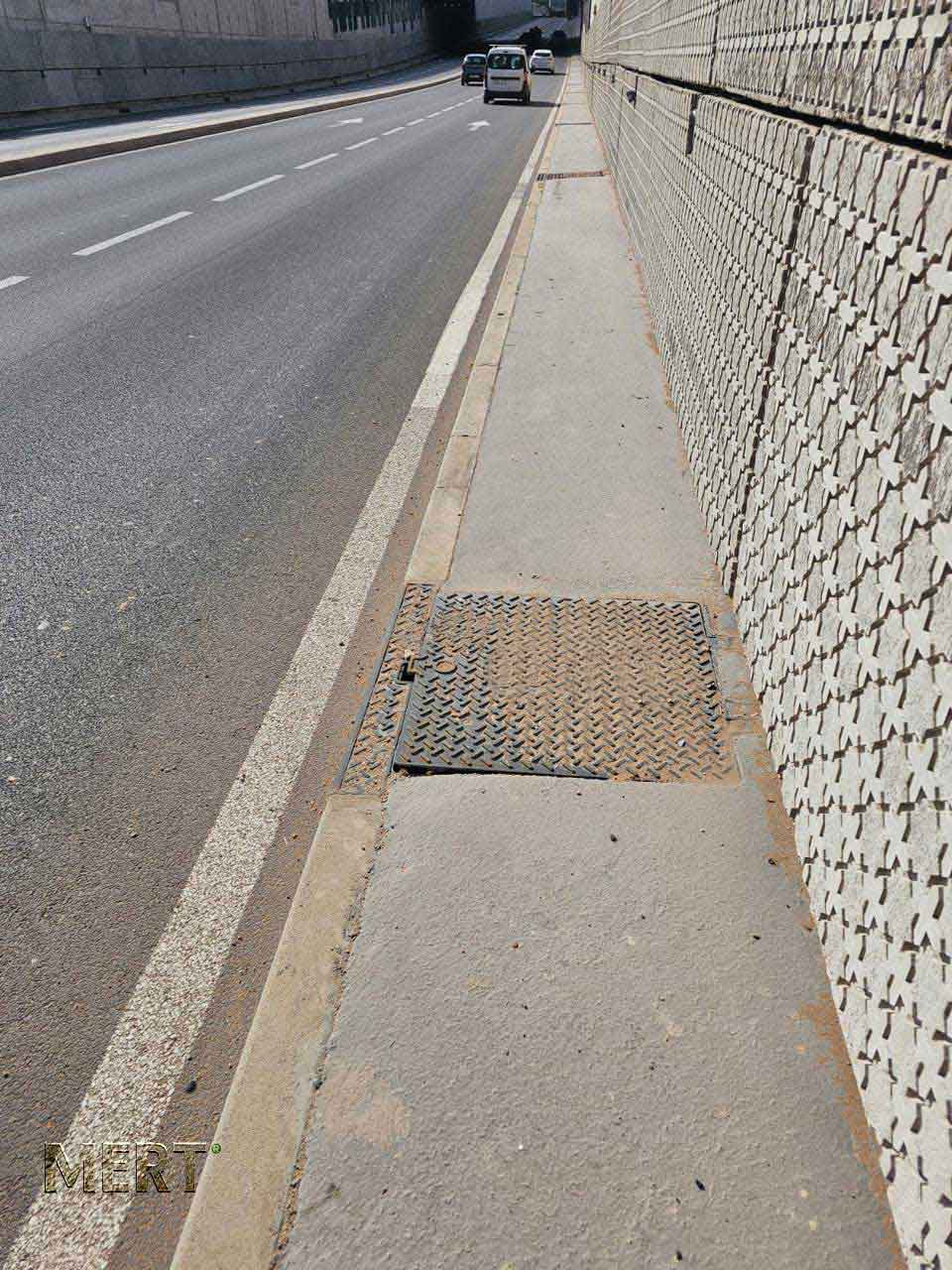 The upper cover provides a direct service point beside the carriageway. Final placement, clear opening, load class and maintenance procedure must be defined for each project.
6. Mert Dokum perspective
The upper cover provides a direct service point beside the carriageway. Final placement, clear opening, load class and maintenance procedure must be defined for each project.
6. Mert Dokum perspective
From field reference to project-specific infrastructure solutions
Mert Dokum studies real infrastructure applications to understand how access, drainage and maintenance requirements come together in the built environment. The objective is not simply to supply an isolated cast component, but to support consultants, contractors and public authorities in selecting durable and maintainable products for the complete application.
For a similar underpass project, the required solution should be developed around hydraulic calculations, traffic conditions, chamber geometry, connection details, corrosion exposure, maintenance access and applicable national or international standards. Product dimensions and performance values must be confirmed through the approved technical submittal for the specific project.
Questions and answers
Frequently asked questions about underpass drainage
Why are road underpasses vulnerable to flooding?
They are lower than the surrounding road network, so runoff from ramps, carriageways and paved areas naturally moves toward them. During intense rainfall, inflow can exceed the available intake, storage, pipe or pumping capacity.
What is a high-capacity kerb inlet?
It is a stormwater collection unit installed along the road edge. Runoff enters through side openings and flows into an underground chamber connected to the drainage network.
Does one drainage inlet guarantee that an underpass will not flood?
No. Flood resilience depends on the full system: inlet number and spacing, downstream network capacity, pumps where required, electrical redundancy, monitoring, overflow strategy and maintenance.
Why is the upper access cover important?
It allows inspection, sediment removal, cleaning, blockage clearance and examination of chamber connections. Without practical access, routine maintenance becomes slower and more disruptive.
Can this concept be adapted for other Moroccan road projects?
Yes, provided the final system is designed for the specific catchment, rainfall criteria, road geometry, traffic loading, underground network and maintenance strategy of the project.